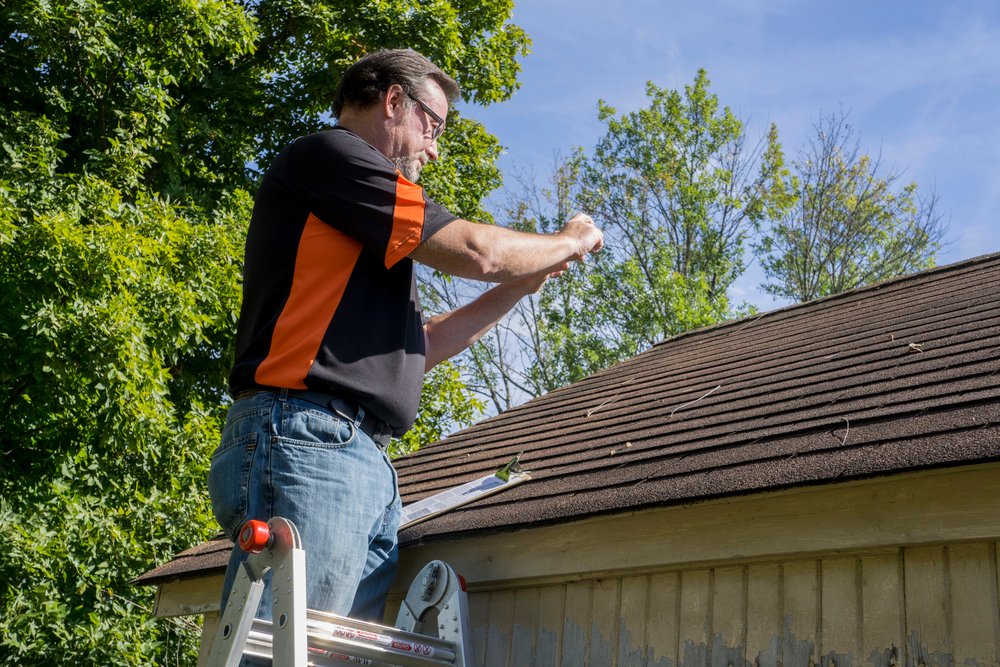
Most sheds need 2 to 4 gallons of exterior paint for two coats. A small 8×8 shed needs about 2 gallons, and a 12×20 needs about 4. The exact amount depends on your shed’s size, roof style, siding texture, and whether you’re using paint or stain.
Enter your shed’s dimensions below to see how much paint, primer, and trim paint to buy, plus your estimated cost. Most sheds have 8-foot walls, which is the default.
How Much Paint Does a Shed Need?
Here’s how much body paint common shed sizes need, assuming 8-foot walls, a standard gable roof, wood lap siding, two coats, and 10% extra for touch-ups. Doors and windows are subtracted from the wall area.
| Shed Size | Paintable Wall Area | Paint for 2 Coats |
|---|---|---|
| 8×8 | ~245 sq ft | 2 gallons |
| 8×10 | ~275 sq ft | 2 gallons + 1 quart |
| 10×12 | ~345 sq ft | 3 gallons |
| 12×16 | ~425 sq ft | 3 gallons + 1 quart |
| 12×20 | ~490 sq ft | 4 gallons (or a 5-gallon bucket) |
Rough-sawn siding like T1-11 needs about 20% more paint than this, and bare or weathered wood can need 50% more. Trim paint is extra. Most sheds need 2 quarts to 1 gallon for the trim and doors.
Paint Coverage by Surface
A gallon of paint doesn’t cover the same area on every surface. Smooth surfaces take the least. Rough, porous, or weathered wood soaks up much more, especially on the first coat. These are the typical coverage rates the calculator uses:
| Surface | Exterior Paint | Solid Stain | Semi-Transparent Stain |
|---|---|---|---|
| Smooth panels / previously painted | ~350 sq ft/gal | ~300 sq ft/gal | ~300 sq ft/gal |
| Wood lap siding | ~300 sq ft/gal | ~275 sq ft/gal | ~250 sq ft/gal |
| Rough-sawn / T1-11 | ~250 sq ft/gal | ~200 sq ft/gal | ~175 sq ft/gal |
| Bare or weathered wood | ~200 sq ft/gal | ~175 sq ft/gal | ~150 sq ft/gal |
| Metal siding | ~350 sq ft/gal | Not recommended | Not recommended |
Primer typically covers about 200–300 square feet per gallon. Coverage also varies by brand. Premium paints with more pigment often cover better, so always check the rate on your product’s label.
How to Measure Your Shed for Paint
If you’d rather do the math by hand, it only takes a few steps:
- Find the wall area. Add up the length of all four walls (the perimeter) and multiply by the wall height. A 10×12 shed with 8-foot walls has 44 × 8 = 352 sq ft of wall.
- Add the gable ends. Each triangular gable is width × roof rise ÷ 2. On a 10-foot-wide shed with a standard pitch, the two gables add about 20 sq ft.
- Subtract doors and windows. A single shed door is about 20 sq ft, double doors about 39 sq ft, and a small window about 6 sq ft.
- Multiply by coats and divide by coverage. 346 sq ft × 2 coats ÷ 300 sq ft/gal = 2.3 gallons. Add 10% for touch-ups and round up, and you’ll need 3 gallons.
For trim, measure the total length of your corner boards, fascia, and door and window casings. If the trim is about 6 inches wide, multiply the total length by 0.5 to get square feet. Gutters work out to roughly 1 sq ft per linear foot.
Paint or Stain: Which Is Better for a Shed?
Exterior paint forms a protective film, comes in any color, and is the easiest choice for matching your house. Choose a 100% acrylic exterior paint. Satin is the most forgiving sheen for siding, and semi-gloss is tougher and easier to clean on trim and doors.
Solid stain covers like paint but is thinner and soaks in more. It’s a good fit for rough-sawn siding and for wood that’s been stained before. Semi-transparent stain lets the wood grain show through. It’s popular on cedar and pressure-treated sheds but needs recoating more often than paint. Stain is made for wood, so for metal sheds, stick with a paint made for metal.
Do You Need Primer?
You can usually skip primer when you’re repainting over paint that’s in good shape, especially in a similar color. Use primer when:
- The wood is bare, new, or gray and weathered
- You’ve scraped or sanded down to bare wood in spots (spot-prime those areas)
- The siding is cedar or redwood, or has knots that can bleed through the paint
- You’re making a big color change, like dark to light
- You’re painting metal with rust spots or bare metal showing
A full primer coat adds a step, but on thirsty surfaces it often saves topcoat paint and helps the finish last longer.
How to Paint a Shed, Step by Step
- Clean. Wash the siding with a scrub brush or pressure washer on a low setting to remove dirt, mildew, and chalky residue. Let it dry completely, which usually takes a day or two.
- Scrape and sand. Remove loose or peeling paint, then feather the edges with sandpaper so they don’t show through the new coat.
- Repair and caulk. Replace rotten boards, fill holes, and caulk gaps around trim, windows, and corners with exterior-grade paintable caulk.
- Prime any bare wood, knots, or metal, as described above.
- Paint the body. Work from the top down, one wall at a time. On lap siding, paint the bottom edge of each board first. On rough siding, use a thick-nap roller and back-brush to push the paint into the grooves.
- Apply the second coat after the first has dried for the time listed on the can.
- Finish the trim and doors with a smaller brush, cutting in carefully where they meet the siding.
Paint on a dry, mild day within the temperature range printed on the can. Avoid direct midday sun, which makes paint dry too fast and show lap marks. Also avoid evenings when dew is likely before the paint has set.

How Much Does It Cost to Paint a Shed?
For most DIY projects, materials are the main expense. A typical 10×12 shed needs 3 gallons of body paint, about a gallon of trim paint, and basic supplies like brushes, roller covers, tape, and caulk, which comes to roughly $200–$250 with mid-range paint. Premium paint, a full primer coat, or a larger shed pushes that higher. Enter your own paint prices in the calculator above for an exact shopping-list total.
Building a new shed instead? Price the whole project with our shed cost calculator, or find a design in our list of the best shed plans.
Shed Painting FAQs
How many gallons of paint do I need for a 10×12 shed?
About 3 gallons for two coats on wood lap siding, plus 2 quarts to 1 gallon for trim and doors. Rough-sawn T1-11 siding needs closer to 4 gallons.
Does a shed need one coat or two?
Two coats is the standard for even color and lasting protection. One coat can be enough if you’re repainting the same color over paint that’s still in good condition.
Can I paint a metal shed?
Yes. Clean off any chalky residue, sand and prime rust spots with a rust-inhibiting primer, then use an exterior paint made for metal, such as a direct-to-metal (DTM) acrylic. Metal’s smooth surface means a gallon goes a long way.
Can I paint over a stained shed?
Usually, yes. Clean the siding, let it dry, and apply a quality exterior primer first so the paint bonds well. Solid stain is another option if you want to cover old stain without full priming.