
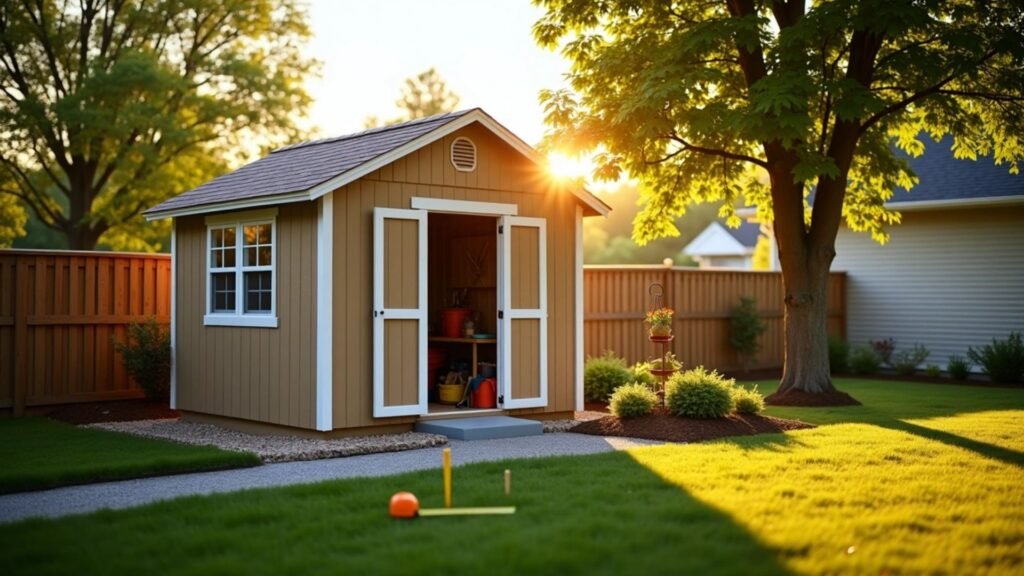
Before you buy lumber or order a kit, the permit question is worth five minutes of research. Skip it, and you risk fines, a forced teardown, or a headache when you sell your house and an appraiser can’t find a permit for the “extra” structure in your backyard. The good news: for most backyard storage sheds, the answer is no permit needed. The catch is that “most” isn’t “all,” and the rules that decide which bucket you fall into are more specific than just square footage.
The Short Answer: It Depends on Three Things
Whether your shed needs a permit almost always comes down to three factors working together, not any one of them alone:
- Size — the shed’s footprint in square feet, measured on the ground
- Foundation — whether it sits on a permanent foundation (like a poured slab) or something removable (skids, blocks, gravel)
- Utilities — whether it has electrical wiring, plumbing, or is intended for people to live or work in
- California sets a single statewide rule: sheds under 120 sq ft are exempt everywhere in the state, though a handful of cities like San Francisco add their own tighter planning-code limits on top.
- Washington sets a 120 sq ft state minimum, but most counties (King, Pierce, Snohomish) raise it to 200 sq ft locally — except Seattle and Vancouver, which hold at 120.
- Texas has no statewide number at all — it’s entirely city by city. Houston exempts sheds up to 120 sq ft, San Antonio goes up to 300 sq ft, and Fort Worth requires a permit for a shed of any size.
- Permanent foundation. A poured concrete slab is generally treated as a permanent structure, which can trigger a permit on its own — independent of the shed’s size. A gravel pad, skids, or concrete blocks are far more likely to keep you under the radar.
- Electrical or plumbing. Running power or water to your shed almost always requires its own permit, no matter how small the building is. This is true even in cities with the most generous size exemptions.
- Height. Most jurisdictions cap permit-exempt accessory structures at 10–15 feet. Go taller — for a loft or steep roofline — and you may cross into permit territory regardless of footprint.
- Setbacks and lot coverage. Even an exempt shed still has to sit a minimum distance from your property line and can’t push your total lot coverage (house + garage + shed + deck) over your zone’s limit. These rules apply whether or not a permit was required to build it.
- Intended use. A shed meant for storage is treated very differently from one meant to be lived or worked in. If you’re planning a she shed, home office, or studio, expect permit requirements that a plain storage shed wouldn’t face.
- Fines and stop-work orders if a neighbor complains or an inspector notices during an unrelated visit.
- Forced removal or retroactive permitting — and after-the-fact permits typically cost two to four times the standard fee, with no guarantee of approval if the structure doesn’t pass inspection as built.
- Trouble at resale. Appraisers won’t count unpermitted square footage, and FHA/VA loans often require proof that every structure on the property is permitted. An unpermitted shed can stall or shrink a sale.
- Insurance gaps. Some homeowners’ policies exclude coverage for structures that were required to be permitted but weren’t.
- Call or search your city/county building department. Ask specifically for the “accessory structure” or “shed” permit exemption size, and mention your planned foundation type and whether you want electricity.
- Check your zoning, separately from your building code. Some cities waive the building permit but still require a zoning or setback permit — a shorter, cheaper process, but still a real requirement.
- Check your HOA’s covenants (CC&Rs) if you have one, before you assume city sign-off is the only approval you need.
A small shed with no power and a gravel pad is the easiest case to skip a permit on. Change any one of those three variables and the answer can flip.
The Size Threshold Almost Every City Uses
The starting point nationally is the International Residential Code (IRC), which exempts one-story detached accessory structures up to 200 square feet from needing a building permit. But the IRC is a model code — individual states and cities are free to adopt it as-is, tighten it, or loosen it, and most tighten it. The two thresholds you’ll run into most often are 120 square feet and 200 square feet.
A few real examples of how differently this plays out depending on where you live:
That range — from “always” to “essentially never” for the same size shed — is exactly why a generic size rule of thumb can get you in trouble. Here’s roughly how popular shed sizes shake out against the two most common thresholds:
| Shed Size | Square Footage | Under a 120 sq ft limit | Under a 200 sq ft limit |
|---|---|---|---|
| 8’ x 8’ | 64 sq ft | Exempt | Exempt |
| 8’ x 10’ | 80 sq ft | Exempt | Exempt |
| 10’ x 12’ | 120 sq ft | Borderline – check exact wording | Exempt |
| 12’ x 16’ | 192 sq ft | Needs a permit | Borderline – check exact wording |
| 12’ x 20’ | 240 sq ft | Needs a permit | Needs a permit |
Use our Shed Cost Calculator to price out a size you’re considering, then check that square footage against your city’s actual threshold before you commit to it.
Size Isn’t the Only Trigger
Even a shed that’s comfortably under your city’s size limit can still need a permit if any of these apply:
And a separate wrinkle worth flagging: even if your city doesn’t require a building permit, your HOA might still have its own approval process for size, color, placement, or style. That’s a completely separate check from your local building department, and skipping it can be just as costly.
What Happens If You Skip the Permit
“It’s just a shed” is a common reason people skip this step, but the downside is bigger than it looks:
A prefab kit shed doesn’t get a pass here, either — permit rules are based on the finished structure’s size and location, not whether you built it from scratch or bought it pre-cut from a home improvement store.
How to Find Out for Sure
Because the exact threshold is set locally, there’s no substitute for checking your own city or county. Three steps will get you a definitive answer in one phone call or website visit:
If you do need a permit, the process is usually straightforward: submit a simple site plan showing the shed’s dimensions and its distance from property lines, pay a fee (commonly in the range of $50–$300 for a basic storage shed, more if electrical or plumbing is involved), and schedule an inspection once it’s built. Most residential shed permits are approved in days to a few weeks, not months.
Once you know your size limit, our Shed Cost Calculator can help you price out options on either side of that threshold — including the materials cut list and build-time estimate — so you can decide whether staying just under the limit is worth the tradeoff. And if you’d rather have a licensed pro handle both the build and the paperwork, you can get a shed construction quote from a local contractor who already knows your area’s rules.